

Why This Matters
- A carrier lookup may identify the operator originally associated with a phone number, not the network serving it today.
- Number portability and changing network information can make previously accurate carrier data outdated.
- Current carrier intelligence gives organizations better information for routing, messaging, fraud mitigation, identity verification, and other operational decisions.
Looking up the carrier associated with a phone number sounds simple. Enter a number, query a database, get a carrier name and line type. But that answer is only useful if the information behind it reflects what is happening in the network now.
Phone numbers move between operators. Number portability allows subscribers to keep their numbers when they change service providers. Network and routing information changes. Line types and text messaging permissions can change. Yet the original carrier assignment can remain associated with a number long after the subscriber has moved elsewhere.
That means an answer that correctly identifies where a phone number started may still be the wrong answer for a routing, messaging, fraud, identity, or other operational decision being made now. Organizations need to know which operator is currently serving a phone number, not simply which carrier originally received it.
What Does a Carrier Lookup Actually Tell You?
A traditional carrier lookup commonly uses information associated with a phone number range or its original allocation to identify the operator connected with that number. That information has value. Code range intelligence remains an important source of carrier information, particularly in markets where number portability is not implemented.
The problem isn’t the data. The problem is assuming that one source of carrier information provides the right answer for every country and every use case.
There are also many carrier lookup services that return a carrier name using previously retrieved or cached information. The lookup itself may happen almost instantly, but that doesn’t necessarily mean the underlying information reflects the network as it exists at that moment. If the number has moved or the network information has changed since the data was collected, the answer can already be obsolete.
That’s an important distinction. Where a number was assigned and who serves it today are not necessarily the same thing.
Why Original Carrier Assignment Isn’t Always Enough
Number portability makes that distinction especially important. When a subscriber moves from one operator to another while keeping the same phone number, the number has been ported. The digits haven’t changed, but the network responsible for serving the number has.
Porting is hardly an edge case. India’s Telecom Regulatory Authority reported that the country passed one billion cumulative Mobile Number Portability requests in July 2024. By March 2025, cumulative requests had climbed to more than 1.118 billion, including 13.54 million MNP requests during March alone.¹
Those are cumulative porting requests rather than a percentage of unique subscribers who have ported, but they illustrate the scale at which numbers can move between operators in a highly competitive mobile market.
That matters when carrier information is being used for an operational purpose. Organizations may need it when:
- Routing an SMS or MMS message
- Routing a voice call
- Determining whether a number is mobile or landline
- Evaluating fraud signals
- Supporting customer identity verification
- Enriching customer data
- Implementing Direct Carrier Billing (DCB)
If the decision depends on knowing the network serving a number now, original assignment alone may not be enough.
Communications Networks Never Stand Still
Portability is only part of the issue. Communications networks themselves are constantly changing. A phone number’s serving carrier can change in seconds. Routing information evolves. Number portability changes network relationships. Information captured at a single point in time begins aging as the network changes.
This is also why “real-time” needs some context when evaluating carrier intelligence. A lookup service can respond in milliseconds while querying information that was collected earlier. The API response may be fast, but the information behind it may not represent the current state of the network.
Speed of retrieval and currency of intelligence are not the same thing.
For organizations using carrier information to make routing, messaging, fraud, identity, or customer data decisions, the age and source of the information can matter just as much as the speed at which the answer is returned.
The Right Source of Carrier Intelligence Depends on the Question
There is no single universal source of carrier intelligence that provides the appropriate answer everywhere.
Depending on the country, regulatory environment, network architecture, and use case, accurate carrier identification may rely on code range information, number portability intelligence, HLR queries for supported mobile messaging use cases, or a combination of intelligence sources.
Each exists for a reason. The challenge for an organization operating across countries and communications environments is determining which source provides the right answer for the particular number and use case.
Organizations shouldn’t have to make that determination themselves.
The real value comes from being able to ask the operational question and receive the appropriate answer without having to manage the underlying differences among carrier intelligence sources, technologies, and regional requirements.
From Carrier Lookup to Live Network Intelligence
Live Network Intelligence goes beyond retrieving carrier information from a single source. It reflects the current network information needed to make an operational decision.
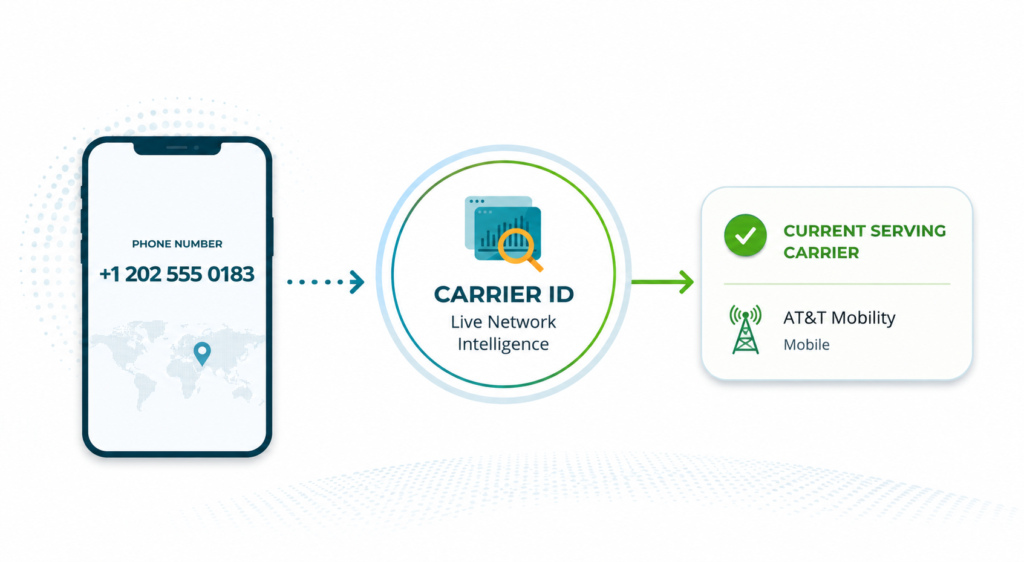
Carrier ID automatically determines the appropriate source of carrier intelligence for the market and use case, correlates that information, and delivers one authoritative answer through a single service. It is delivered through netnumber’s patented global cloud architecture, designed to provide low-latency access to current phone number intelligence at global scale.*
The customer isn’t simply receiving access to carrier datasets. The complexity of sourcing, maintaining, normalizing, and correlating carrier intelligence happens behind the service. Instead of determining which data source to query, managing multiple datasets, or maintaining regional update processes, organizations can use Carrier ID to get the network intelligence required for the decision at hand.
Carrier ID doesn’t simply tell you something about a phone number. It helps tell you how that number is being served now.
*The global cloud architecture supporting Carrier ID was granted U.S. Patent No. 12,499,148 on December 16, 2025. The architecture was originally announced by netnumber in August 2024 while the patent was pending.
What Can Current Carrier Intelligence Help You Do?
Improve Routing Decisions
Identifying the current serving carrier can support more accurate SMS, MMS, and voice routing. Rather than assuming traffic belongs on the network associated with the number’s original assignment, routing decisions can be made using current carrier information.
Improve Messaging Performance
Current carrier and line type information can help determine how communications should be routed and delivered. For messaging providers, CPaaS platforms, and other organizations handling high volumes of traffic, better carrier intelligence can support more informed routing decisions and reduce reliance on outdated network information.
Support Fraud Mitigation and Identity Verification
Carrier information can also become another signal in fraud and identity workflows. Current network and line type intelligence can be combined with other phone number intelligence when evaluating a number, customer, or transaction, giving fraud and identity systems more context for making risk decisions.
Keep Customer Data Current
Customer records can outlive the carrier information originally associated with them. Enriching those records with current carrier and line type information helps organizations maintain more useful phone number data across systems that depend on it.
More Than a Lookup
A carrier lookup answers a question. But organizations operating across dynamic global communications networks often need more than a carrier name associated with a number.
They need to know:
- Who is serving this number now?
- Is it mobile or landline?
- What network information should inform the decision I’m making?
Carrier ID delivers Live Network Intelligence designed to answer those questions using current carrier information rather than relying on a single source or point-in-time view of the network.
Learn How Carrier ID Works
See how Carrier ID delivers live network intelligence to identify the current serving carrier and phone number type across global communications networks.
Sources
1. Telecom Regulatory Authority of India (TRAI), Mobile Number Portability and Telecom Subscription Data. TRAI reported that India crossed one billion cumulative MNP requests on July 6, 2024; its March 2025 subscription report recorded 1.11894 billion cumulative MNP requests and 13.54 million requests during March 2025.
Patent reference: U.S. Patent No. 12,499,148, “Apparatus and method for providing telecommunication routing data,” granted December 16, 2025.